
A dead battery is the most common roadside emergency — and a portable jump starter means you never need to wait for another car or a tow truck. Modern lithium-ion jump starters pack 1,000–2,000 peak amps into a unit that fits in a glove box, replaces a traditional lead-acid jump pack at 1/5th the weight, and doubles as a power bank for USB devices.
We evaluated peak current output, cold cranking amps, engine size compatibility, safety features, battery capacity, and real-world reliability to find the best jump starters for every driver.
What to Look For
- Peak amps vs. cranking amps: Peak amps is the maximum burst the unit can deliver — cranking amps is the sustained output needed to actually start an engine. Most lithium starters list peak amps prominently; look for units with at least 400 cranking amps for reliable starts on larger engines.
- Engine size compatibility: A 1,000A unit handles up to 6.0L gas and 3.0L diesel. A 2,000A unit handles up to 8.0L gas and 6.0L diesel — necessary for trucks, SUVs, and European diesel engines.
- Safety protection: Reverse polarity protection (to prevent sparks if clamps are accidentally reversed) and overload protection are non-negotiable. NOCO's UltraSafe technology is the industry standard.
- Cold weather performance: Lithium batteries lose capacity in extreme cold. Units rated for use down to -4°F (-20°C) will still work in winter conditions; cheaper lithium cells may fail to deliver enough current below freezing.
- Built-in flashlight: Useful but not essential. A strong LED flashlight on the unit is genuinely helpful for dark parking garages and nighttime breakdowns.
Our Top Picks

NOCO Boost GB40 12V 1000A Jump Starter
1,000 peak amps handles engines up to 6.0L gas and 3.0L diesel — covers the vast majority of passenger vehicles. Patented spark-proof technology with reverse polarity protection means it's impossible to cause damage even if clamps are connected incorrectly. Recharges in 3 hours via USB-C. Doubles as a USB power bank. The most-reviewed and highest-rated lithium jump starter on the market for good reason.

TOPDON JS2000Pro 2000A Jump Starter
2,000 peak amps and a Boost Mode for completely dead batteries — the JS2000Pro can jump-start engines up to 8.0L gas and 6.0L diesel, covering full-size trucks, diesel pickups, and large European engines. Includes a built-in 100W USB-C port for laptop charging, a bright 1,000-lumen LED flashlight, and a 12V/10A DC output for running accessories. The best choice for truck owners and anyone who needs more headroom.
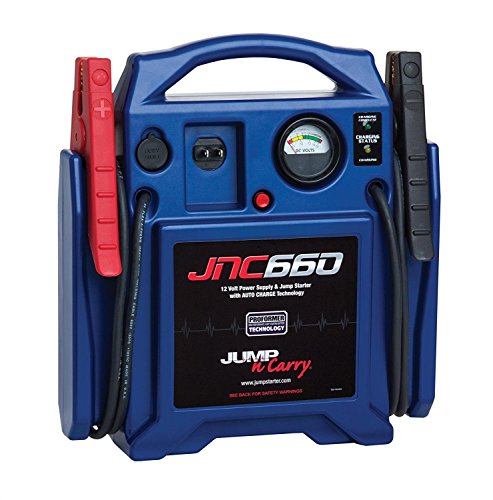
Clore Automotive Jump-N-Carry JNC660 1700A
The JNC660 is the professional-grade lead-acid jump starter used in auto shops, service fleets, and by roadside assistance technicians for decades. 1,700 peak amps with 425 cranking amps — the highest sustained cranking output of any portable unit in this category. Lead-acid construction means it works reliably in extreme cold where lithium units struggle. Heavier (18 lbs) but built for daily commercial use. Best for trucks, heavy equipment, and diesel vehicles in cold climates.
Bottom line: The NOCO GB40 is the best jump starter for most drivers — compact, safe, and powerful enough for any passenger vehicle engine. Truck and diesel owners should step up to the TOPDON JS2000Pro. The Clore JNC660 is the best choice for professionals and cold-climate drivers who need maximum cranking amps from a lead-acid unit.
Frequently Asked Questions
How long does a lithium jump starter hold its charge?
Quality lithium jump starters like the NOCO GB40 hold their charge for 12–18 months in storage with minimal self-discharge. Lead-acid units like the JNC660 need to be recharged every 30–90 days to prevent sulfation. Check the manufacturer's storage recommendations and recharge before winter storage.
Can a jump starter charge a completely dead battery?
A jump starter provides the burst current needed to start the engine — it doesn't charge the battery. After jump-starting, run the engine for at least 20–30 minutes to let the alternator recharge the battery. If the battery dies again quickly, it needs replacement, not just another jump.
What's the difference between peak amps and cranking amps?
Peak amps is the maximum current the unit can deliver for a fraction of a second. Cranking amps is the sustained current delivered for 30 seconds at 32°F — the real-world number that determines whether it can start your engine. A unit with 1,000 peak amps but only 200 cranking amps may struggle on larger engines in cold weather.


